I was very lucky. I was asked if I would like to contribute ten of my top stone fruit varieties. I was then featured in the August edition of The English garden magazine.
I said yes of course and thought it would be good to go through my choices on here. Especially now it’s bare root fruit buying season.
I have tried to keep it brief but much more could be said in this post about each variety and why I chose them.
I really should have used Blu tack to stick the magazine down!
It was difficult as I haven’t grown many stone fruit varieties. On the farm we grew more commercial varieties and at work the stone fruit are mostly French heritage varieties.
So, in no particular order here are my chosen top ten stone fruit for growing in the UK.
1, Cambridge Gage
The Cambridge gage is a prolific cropper with very small, sweet, yellow plums. However, they do not store well at all and are bruised incredibly easily so bear that in mind. People used to travel a great distance to come and buy these. So, it doesn’t hurt to have a row or tree in your orchard.
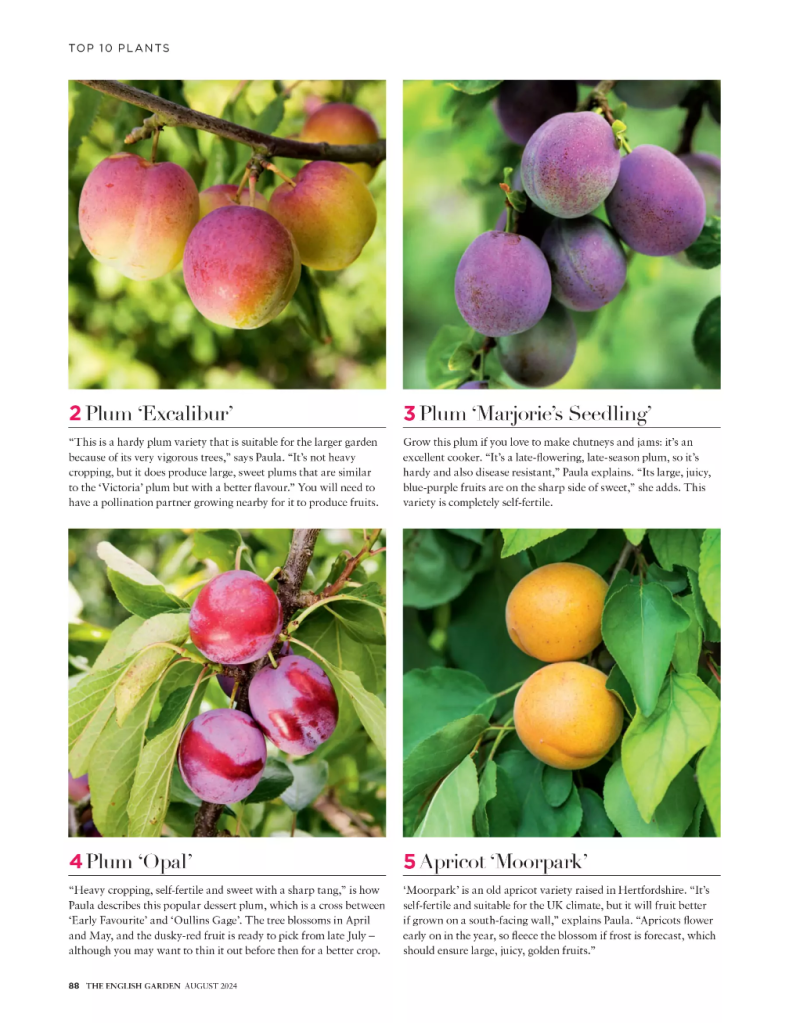
2, Excalibur Plum
I included the Excalibur plum as it produces enormous fruit (and trees!!) It’s a dessert plum and is much rounder than the average large plum. They are often yellow or orange when grown in sunny sites or at the tops of trees. They are not as prolific as Opals or Victoria but this allows for the larger plum. They are a joy to pick due to their size and quite a conversation starter I have found.
3, Marjorie’s seedling plum
The “Marjories” as we used to call them always cropped well, often needing thinning. They are a late plum and the late blossom means it’s less susceptible to frost. They are self fertile, this means they are suitable for one tree in a garden. However, two or more trees will always mean a better crop. It is a purple plum with a green/yellow flesh and you can cook or eat them straight from the tree.
4, Opal Plum
Now, Opal plums are my favourite and in my opinion are much better than a Victoria plum (gasp!). I used to look forward to them each year. I feel a little sad I don’t grow them in the orchard I now look after. However, I absolutely intend to grow them at home.
5, Moorpark Apricot
Moorpark is renowned for being a good variety to grow in the UK. The village Aynho is also known as the Apricot village. It is located on the Oxfordshire/Northamptonshire border. They have grown apricots there since the late 19th century. You can still see that tradition alive today on some of the houses. A south facing wall of course helps but we managed to grow them on the farm in the open…with varying degrees of success.
6, Avalon Peach
I have included Avalon peach because it’s highly regarded as being one of the best Peach trees to grow in the UK. Especially if you intend to grow them outside. This is due to their disease resistance to Peach leaf curl, a problem I have to deal with a lot on our peach trees.
They do flower well but will probably need hand pollinating. Also fleecing the blooms is essential so they escape frost damage.
7, Mirabelle de Metz
I have a bitter sweet relationship with these. I grow them in our orchard as they are the favourite of my boss. However, they are small and prolific and take a long time to pick. They do not keep well and bruise easily but do not be put off. They taste lovely and I am glad we have them….until we are picking!
8, Purple Pershore plum
I must confess to have never grown the Purple Pershore plum. However, I love that there is the Pershore plum festival which is held every year celebrating this fruit. It’s well worth a visit. The Purple Pershore plum is a heritage variety of Plum dating back to 1877 originating from Pershore in Worcestershire, UK.
It is a purple plum with a red hue. It has some disease resistance and is well suited to our climate. It crops well and is not very sweet or juicy so is used more on the culinary scale. That said, everyone has different preferences. Many people like to eat it straight off the tree.
9, Stella Cherry
An easy to grow, easy to buy, tasty Cherry. I have grown this and like all cherries they will need fleecing if frost is forecast at blossom time. They will also need netting to keep birds away. The birds do not wait for them to ripen so be vigilant, net early!
I have witnessed blackbirds literally jumping on the nets as they try to get through the barrier…it was really quite comical and I was a smug grower that year!
10, Tomcot Apricot
Tomcot is a variety suitable to grow outside in the UK. If you hand pollinate and Fleece the blooms when frost is forecast you should get a decent crop. A south facing wall will help if you have one. However, apricots are thirsty and will require more watering because of the wall’s shade.
A big thank you to The English Garden Magazine for featuring me in your magazine!


 The Grounded Orchardist
Leave a comment