Ugh, when the aphids get to the trees long before you do. That’s another years rest for the Damsons then. (a bit of positivity there!)

It was a bit of a shock when I approached the Damson trees as the leaf quality over all the other trees is fantastic this year!
Luckily, I’m still training these trees after a rejuvenative prune so we wouldn’t have got a lot of fruit off them anyway. That said, I really wanted some leaf on them this year…and we will. Just not quite as soon as I would have liked.
It’s amazing how quick these things can take over. The aphids are sucking the life out of this lush new growth and the leaves can’t photosynthesise efficiently. After all, if you crumple up a solar panel it’s not going to be as efficient. Think of the leaf as the solar panel of the tree. Therefore both these things stress out the tree. Also the aphids carry viruses which can pass onto the tree and we may not see the effects of any viruses for a few seasons. The stressed out tree cannot take up water and nutrients efficiently which is a problem at the moment. These trees are fairly big so I want them to dig deep and find that water hidden away especially in this warm weather. They are now at a disadvantage….but we’ll get them back! 🌳
So, what’s the plan
I took off the shoots I didn’t want. Then on any new growth I wanted to keep, I took off the worst of the affected leaves. These still contain the aphids…so they were destroyed with much enthusiasm! 🪲💪
I made sure I kept the leaf buds and any basal clusters if I had to go that far back. New leaves and shoots should come in soon and I’ll keep an eye on them.
In the meantime…perhaps a skyscraper sized bug hotel may be in order.
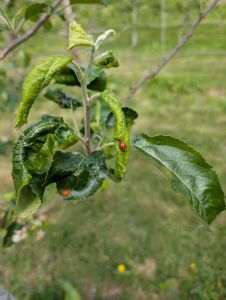

In less exposed areas of the orchard we have help against the aphids!
Not just Ladybirds of course but also include numerous hoverfly larvae, parasitic wasps, birds, beetles, earwigs, spiders and many more. Oh, and me! 😂
It can make all the difference from a whole tree affected, like the Damsons shown above, to being a small branch or two. As organic growers you accept there will be a bit of damage here and there. As long as there is a balance and it’s not the overriding factor in the orchard.
As a side note, although earwigs are amazing on top fruit…you wouldn’t want them on your stone fruit!
Rosy leaf curling aphid


In keeping with plenty of aphids this year there are more Rosy leaf curling aphid numbers then I have seen before.
Tell tale signs are the curled leaves on apple trees but even more helpful is the red on the leaves! If you open up the curled leaves you can see the aphids inside.
They are not as prevalent as other aphids, or maybe I’ve just got lucky. I still take them out when I see them though.
Just take the affected leaves or shoots out of the trees. Easy to do at home, not so easy to do on a large scale. My thinking is that any I have missed will be taken care of by nature, hopefully!
Excuse the dirty nail….a proper gardener thumb that is! 🙂
Woolly aphid
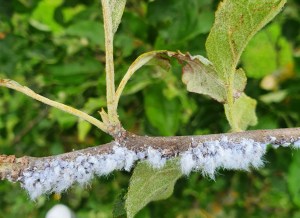

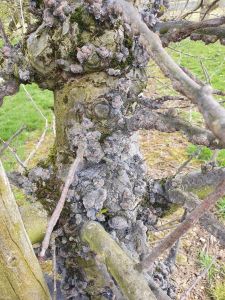
There are little blobs of woolly aphid around, nothing too horrendous as yet. I just grab a leaf and give them a little squash. I don’t have time to make sure they’re all squashed, so again, this is about reducing numbers so they’re not dominant in the orchard.
They are generally not sucking the leaves but the bark tissue. Causing unsightly lumps and bumps over the affected area. See picture above. The wool, which is really wax, protects them from spray and predators.
We experimented a couple of years ago with keeping the grass long at the base of the tree. Unfortunately it seemed to give the Woolly aphid a lovely place to hide. This meant I had to bend to sort them and get underneath the tree canopy. That made the control very slow. Lesson learned, we won’t do that again!
 The Grounded Orchardist
Leave a comment